Kicks & Collectables Not for you.
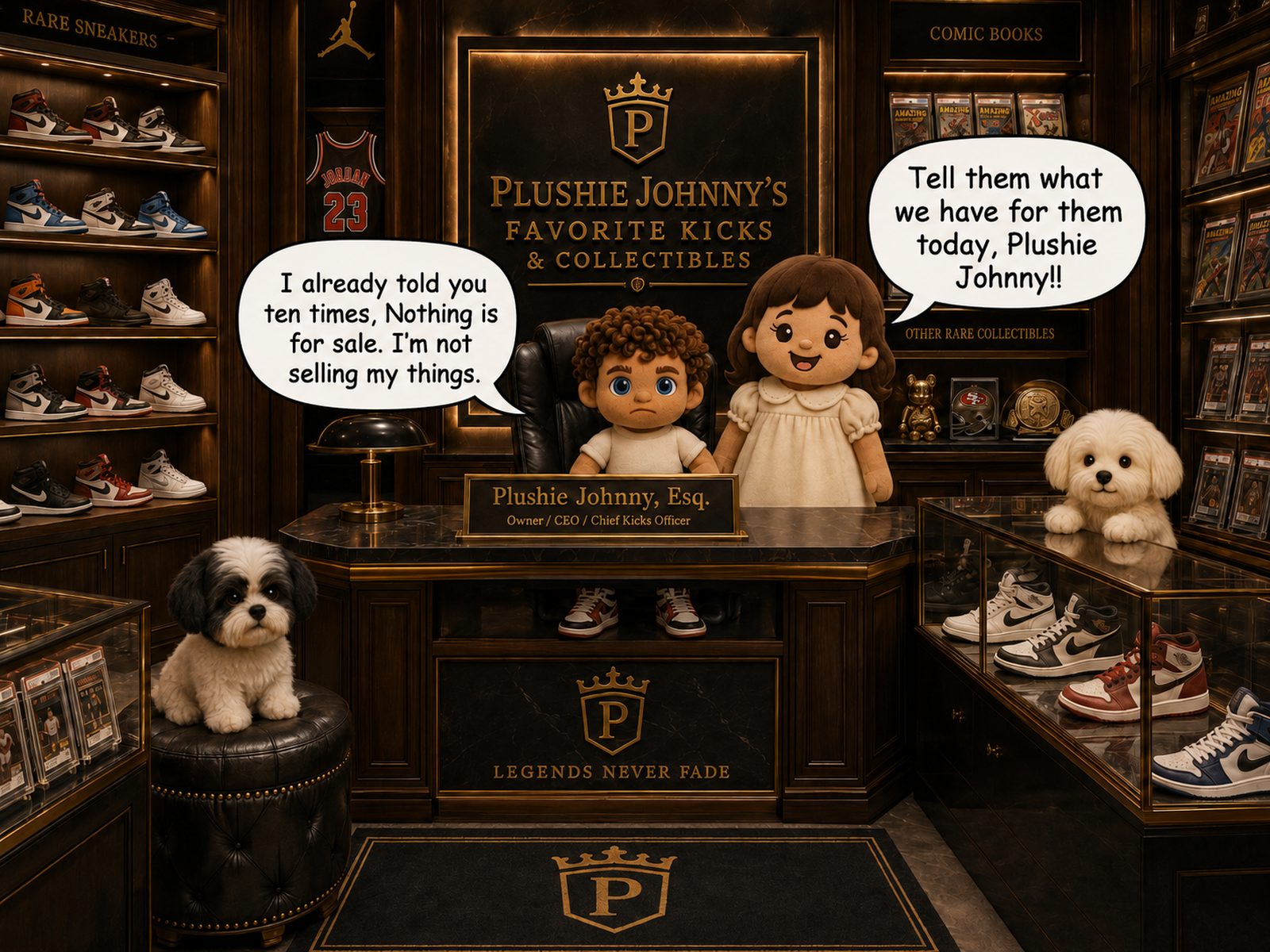
This is Plushie Johnny’s stockroom. He is five, he is a genius, and he does not want to sell you anything. You may look. Quietly. Then you may leave.
PS: He doesn’t like to talk.
Sample glossary
Salesman SamplePre-production pairs made strictly for internal presentation, trade shows and wholesale account meetings.
Nike Salesman Samples are specialized pre-production sneakers manufactured strictly for internal presentation, trade shows, and wholesale account meetings. They allow internal sales representatives (reps) to pitch upcoming seasonal footwear lines to corporate buyers and local retail accounts (e.g., Foot Locker, independent boutiques) long before mass production begins.
This comprehensive report breaks down the definition, indicators, history, legality, and culture surrounding these highly coveted artifacts.
1. The complete definition & purpose
Within the broader category of "Nike Samples" (which includes Look-See Samples, Wear-Test Prototyping, and Friends & Family variants), Salesman Samples (often categorized as "SS" or Promo Samples) serve as physical marketing tools.
Their primary function is to secure inventory pre-orders from retail stores. Because they are finalized at the "adoption" stage of the seasonal design cycle, they feature consumer-ready aesthetics but are manufactured months before the retail versions hit the shelves.
2. Anatomy of a salesman sample
You can reliably recognize a Nike salesman sample by checking for five distinct physical characteristics, with the shoe's size and internal tags being the absolute dead giveaways.
The Golden Rule: Men's Size 9 (or Women's Size 6)
- The universal sample size: Nearly all male Nike salesman samples are manufactured exclusively in a Men's US Size 9. Women's sneaker samples are manufactured in a Women's US Size 6.
- Why? This size fits perfectly into standard marketing display molds and keeps the visual proportions of the shoe symmetric for sales pitches. If you find a "sample" in a size 11 or 12, it is likely a player-exclusive or a wear-test shoe, not a salesman sample.
Internal tag markings
Look closely at the manufacturing tag stitched inside the tongue or on the inner side panel. A salesman sample will feature explicit text instead of standard retail data:
- Promo text: It will prominently state "SAMPLE", "PROMO SAMPLE", or "PROPERTY OF NIKE - NOT FOR RESALE".
- The SKU code: Retail shoes have a specific 9-digit code (e.g.,
123456-100). Salesman samples often feature a string of zeros (like000000-000) or the letters "SS" written directly on the tag or stamped nearby, standing for "Sales Sample."
The ink "Sample Stamp" (vintage pairs)
- If you are looking at a Nike shoe from the 1980s or 1990s, the factory often stamped the word "SAMPLE" in bold, indelible ink.
- This stamp is usually located directly on the sockliner (insole), inside the collar lining, or right on the raw underside of the tongue fabric. Over time, these ink stamps may fade, but a ghostly outline will usually remain visible.
Advanced production timelines
- Look at the factory production dates listed on the tag.
- Salesman samples are manufactured 6 to 9 months before the shoe ever debuts at retail stores.
- The tag will usually list a seasonal code corresponding to Nike's internal quarterly product cycle: SP (Spring), SU (Summer), FA (Fall), or HO (Holiday), followed by a year that predates the shoe's official public release.
Physical "unreleased" discrepancies
Because salesman samples are made before mass-production factory assembly lines are fully dialed in, look for things that "don't match" the retail pair:
- Alternate materials: Higher-tier leathers, a different texture of leather, a different mesh weave, or a completely unreleased color scheme that Nike executives ultimately canceled.
- Construction quirks: Minor stitching variations, different colored eyelets, or alternate branding placements that were adjusted later on to save mass-production costs.
3. History & evolution
The concept of the salesman sample traces back to the inception of the company.
The Trunk Show Era (1960s–1970s): In the early days of Blue Ribbon Sports (BRS), co-founder Phil Knight and early employee Jeff Johnson literally sold running shoes out of the trunks of their cars at track meets. Their "salesman samples" were simply the actual stock they could get from Onitsuka Tiger.
The B2B Boom (1980s–1990s): As Nike grew into a global corporate powerhouse, they instituted a formalized, rigorous internal infrastructure. Sales reps were issued specialized plastic rolling trunks packed to the brim with physical sample shoes representing the upcoming quarters. Representatives traveled door-to-door to mom-and-pop sneaker shops and major athletic chains to pitch the lines.
The Digital Shift (2010s–Present): While physical salesman samples are still manufactured for tier-one accounts and major trade shows, Nike has increasingly transitioned to digital catalogs, 3D renderings, and augmented reality to streamline pre-orders and reduce carbon waste. This digital shift has made modern physical salesman samples exponentially scarcer.
4. Quantity produced & what happens to them
General production runs: The exact quantity depends on the silhouette's scale, but general industry consensus places the volume of salesman samples anywhere from 50 to 500 pairs worldwide per colorway. One pair is usually allocated per regional sub-district or major showroom.
The intended fate: Officially, Nike corporate policy mandates that when a sales cycle closes, all samples must be returned to the company's world headquarters in Beaverton, Oregon. From there, they are strictly slated to be destroyed / shredded or kept deep within the internal Nike Archives ("The DNA Vault").
How they slip out: Despite corporate rules, hundreds of samples escape every year. Reps frequently gift them to friends, sell them quietly to local sneaker store owners, donate them anonymously to thrift shops near corporate hubs, or simply leave them behind in store backrooms where employees intercept them.
5. Corporate position: does Nike want you to have them?
Absolutely not. Nike legally maintains that all sample sneakers remain the permanent intellectual property of Nike, Inc. The company explicitly forbids their distribution, sale, or transfer to the general public.
Legal disclaimers: The "Property of Nike: Not for Resale" stamp serves as a legal barrier designed to deter third-party marketplaces from hosting them.
The reason for secrecy: Nike restricts sample releases because these shoes have not passed general consumer safety testing. Furthermore, a sample might feature design flaws or unapproved color schemes that conflict with Nike's strict marketing directives. While it is legal for an individual under the "First Sale Doctrine" to sell physical goods they legally possess, platforms like eBay, Depop, or StockX may occasionally pull sample listings if Nike aggressively flags them for intellectual property violations.
6. Desirability & sneaker culture reception
In the sneaker community, salesman samples are viewed as the holy grail of archival collecting.
| Attribute | Retail release sneaker | Salesman sample sneaker |
|---|---|---|
| Availability | Mass-produced (thousands/millions) | Ultra-limited (usually under 100–500 pairs) |
| Aesthetics | Finalized, standardized design | May feature alternate materials, unreleased colors, or custom branding |
| Market value | Variable based on hype | Consistently command high premiums via premium auction houses |
| Sizing variety | Full size runs | Dominated exclusively by Men's Size 9 / Women's Size 6 |
Because a size 9 sample might represent a legendary shoe in a color palette that Nike executives ultimately vetoed, collectors pay staggering premiums to own "what could have been." High-end auction houses like Sotheby's routinely broker sample pairs for thousands of dollars to high-net-worth sneaker curators.
7. Notable anecdotes & unreleased artifacts
The 1984 Air Jordan 1 samples: Before Michael Jordan's rookie season officially launched the Air Jordan craze, Nike built early 1984 Air Jordan 1 salesman samples. Many of these early samples featured slightly different leather cut lines, different block lettering on the collar instead of the classic "Wings" logo, and altered toe-box perforation counts. These rare artifacts fetch tens of thousands of dollars on the secondary market today.
The vetoed "Olympic" colorways: In the early 1990s, Nike fabricated various Basketball and Force line salesman samples intended for Olympic athlete pitches. Some of these iterations featured vibrant, experimental patriotic accents that never passed corporate approval, leaving the physical salesman samples as the only proof that those colorways ever existed.
Looksee SamplePre-production pairs made for internal aesthetic review, colorway testing, material evaluation and executive sign-off.
Nike "Looksee" samples represent one of the most fascinating, secretive, and highly coveted subcultures within sneaker collecting. They are the physical blueprints of sneaker design, serving as a critical midway bridge between a designer's raw digital sketch and the final mass-produced shoe sitting on retail shelves.
This comprehensive report breaks down the definition, history, mechanics, and culture surrounding these legendary artifacts.
1. The complete definition & purpose
A "Looksee" sample (often written as Look-See) is a pre-production sneaker manufactured primarily for internal aesthetic review, colorway testing, material evaluation, and executive sign-off.
Unlike "wear-test" samples—which are built for athletes to destroy on-court to test structural durability—a Looksee sample's job is explicitly implied by its name: to look at and see. Nike's product managers, designers, and marketing executives use these physical pairs to determine if the colors look right under room lighting, if the textures mesh well together, and if the overall silhouette commands presence in person.
2. Detailed history & evolution
The concept of the Looksee sample was born out of manufacturing necessity in the late 20th century as Nike scaled its global operations.
The Early Blueprint Era (1970s–1980s): In Nike's early days, prototyping was highly localized (often done manually in Oregon by figures like Bill Bowerman). However, as mass production shifted to overseas factories in Asia, a standardized method was needed to check factory interpretation of design tech-packs before spinning up heavy machinery.
The Sales Rep Boom (1990s–2000s): Looksee samples doubled as "Sales Samples" or "Promo Samples" during this golden era. Nike's regional sales representatives traveled to independent sneaker boutiques with bags full of Looksee samples to give shop owners a physical preview of the upcoming season. Store owners literally had to "look and see" to decide how many pairs they would pre-order.
The Modern Digital Era (2010s–Present): With the advent of hyper-realistic 3D digital rendering and rapid 3D printing at Nike's World Headquarters (WHQ) in Beaverton, Oregon, the total volume of physical Looksee samples has drastically decreased. However, physical factory samples remain an unskippable final check before retail validation.
3. Anatomy of a Looksee sample
A sneaker is uniquely identified as a Nike Looksee sample through several highly specific manufacturing and design hallmarks.
The "Sample Size" rule
- US Men's Size 9: Almost all standard Nike men's Looksee samples are manufactured strictly in a US Men's Size 9. Size 9 is the industry-standard baseline grading size from which all other shoe patterns are scaled up or down.
- US Women's Size 6: For women's sneakers, the baseline sample size is a US Women's Size 6.
- Note: If a sample shoe is a larger size (like an 11, 12, or 13), it is usually a "Player Exclusive" or an athletic wear-test pair, not a classic corporate Looksee sample.
The internal size tag
- The "999999999" code: On the inner tag, the standard 9-digit retail style-color SKU code is completely replaced by a string of all nines (
999999999or999999-999). - Advanced production dates: The manufacturing dates printed on the tag are usually 6 to 12 months prior to the shoe's eventual retail release date.
- Season codes: Looksee tags feature seasonal development codes indicating when the boardroom review took place: SP (Spring), SU (Summer), FA (Fall), or HO (Holiday), followed by the two-digit year (e.g.,
SP06,SU24,FA26,HO12).
Stamped text & branding
- The "Not For Resale" stamp: The inner collar lining, the backside of the tongue, or the sockliner is often stamped or heat-transferred with bold text reading: "SAMPLE, PROPERTY OF NIKE, NOT FOR RESALE".
- Developmental fonts: The inner tags often look primitive compared to retail tags, sometimes featuring typed text, handwritten marker notations, or factory tracking stickers directly on the insoles.
Material and design discrepancies
- Scrapped details: Looksee samples often feature entirely different leathers, mesh, stitching styles or patterns that Nike ultimately decided were too expensive or difficult to mass-produce.
- Experimental colorways: They may sport unique color-blocking, experimental logos or logo placements that look completely different from the final version that hit retail shelves.
4. Quantity produced & factory lifecycle
Because they are meant strictly for boardroom review and sales pitches, production numbers are incredibly low.
The numbers: Typically, a single colorway will yield anywhere from 5 to 50 pairs of a Looksee sample globally.
What happens to them? Legally and operationally, Looksee samples are meant to be destroyed. Nike policy mandates that factory samples be slashed/cut through the sole (to render them unwearable) and thrown into industrial shredders or recycling bins.
The great escape: Despite strict security, pairs regularly slip through the cracks. They are gifted to elite internal designers, hoarded by factory workers, acquired by high-level brand ambassadors, or sold off heavily discounted at employee-only Nike Company Stores or local BRS warehouse clearance events.
5. Corporate stance: does Nike want you to have them?
The short answer is absolutely not.
Nike vigorously polices the proliferation of samples. Legally, a sample remains the intellectual property of Nike, Inc. indefinitely. Over the decades, Nike has aggressively cracked down on secondary platforms and issued cease-and-desist notices to consignment shops or individual collectors trying to auction high-profile unreleased samples.
Nike hates them being in the wild for two major reasons:
- Leaked IP: It spoils their long-term marketing timelines and exposes early design secrets to competing brands.
- Quality liability: Because Looksee samples are built for aesthetic evaluation, they occasionally skip the strict safety and structural durability tests required for commercial footwear.
6. Desirability & the tiered collectibility market
In the sneaker community, Looksee samples are viewed as the absolute pinnacle of collecting, sitting comfortably beside "Friends & Family" pairs. Their valuation is split into two distinct tiers:
| Sample category | Description | Market desirability |
|---|---|---|
| Released variant samples | Looksee samples of a shoe that eventually did release, featuring minor tweaks (e.g., a white midsole instead of black). | Moderate to high. Highly prized by purists who want to show the evolutionary lineage of a famous shoe. |
| Unreleased samples | Shoes that were outright scrapped by executives during the "Looksee" meeting and never manufactured for retail. | Astronomical. These are effectively museum-grade fine art pieces. Collectors will pay thousands—or tens of thousands—of dollars for an unreleased Nike SB Dunk or Air Jordan sample because it shouldn't exist. |
7. Famous stories & anecdotes
The "What The" Dunk: Released in October 2007, the Nike SB "What The" Dunk was built from pieces of 31 separate earlier Nike SB Dunks, with a design goal to be "the Dunk to end all Dunks." It was the sneaker component of Nike SB's Nothing But the Truth skate video campaign.
The eBay Dunk: In 2003, Nike SB quietly made a single pair of the "eBay" Dunk Low and auctioned it on eBay for charity. The patent leather samples were sawed into pieces so the auctioned pair would stay one of one. In December 2022, Nike reissued the shoe with translucent "chopped-up" windows that echo the cut samples, plus insoles honoring Nike SB pioneer Sandy Bodecker.
CFM SampleThe final pre-production pair that confirms a factory can mass-produce the sneaker to Nike's exact specifications.
A Nike CFM Sample (Confirmation for Manufacturing Sample) represents a highly specialized, late-stage milestone in Nike's footwear production pipeline. Positioned at the critical boundary where a design transitions from an experimental concept to mass-market manufacturing, these pairs are intensely sought after by high-level collectors due to their extreme scarcity and industry-exclusive origins.
1. Definition and role in the production pipeline
Within Nike's corporate supply chain, the development process follows a highly disciplined timeline from ideation to consumer delivery. Samples are generated at several stages, including early-stage "Look-See" prototypes, Fit/Wear-Test versions, and "Sales/GTM" (Go-To-Market) representative models.
The CFM Sample is produced specifically to confirm and sign off on a contract factory's ability to mass-produce the sneaker according to Nike's precise material, structural, and aesthetic specifications. It is the ultimate blueprint. Once Nike's product managers, developers, and quality assurance teams inspect and "confirm" a CFM pair, that specific factory receives the authorization to begin mass fabrication.
2. Physical characteristics & identifiers
A sneaker is identified as a Nike CFM Sample by several distinct physical markings, manufacturing tags, and structural anomalies. Because these pairs serve as the final factory checkpoint before mass production, they leave a unique paper and material trail.
The internal sample tag
The most definitive proof of a CFM sample is found on the inside size label (typically stitched to the tongue or inner lining). Unlike retail tags, which feature standard barcodes and commercial layout details:
- The CFM designation: The tag will explicitly feature the printed text "CFM SAMPLE", "GTM CFM SAMPLE", or "CONFIRMATION SAMPLE".
- The corporate warning: It almost always includes the strict legal advisory: "SAMPLE PROPERTY OF NIKE - NOT FOR RESALE" or "NOT FOR RETAIL SALE".
- Production timeline dates: The production dates printed on a CFM tag are typically 3 to 9 months earlier than the actual retail release date of that specific sneaker.
The "Sample Size" rule
Nike builds its baseline structural patterns around uniform reference sizes to ensure quality control testing is standardized across all global factories.
- Men's models: Historically cut exclusively in a US Men's Size 9 (UK 8 / EU 42.5 / 27cm).
- Women's models: Women's sneaker samples are cut in a US Women's Size 6 (UK 3.5 / EU 36.5 / 23cm).
- Note: While exceptions exist for player-exclusive (PE) or hyper-specific athlete wear-tests, a true production-line CFM sample outside of these two sizes is extraordinarily rare.
Handwritten factory markings
Because these pairs are heavily inspected by product managers, developers, and factory supervisors, they are treated as working documents.
- Midsole/upper notes: It is common to find handwritten numbers, initials, checkmarks, dates, or colorway codes scrawled directly onto the foam midsoles, leather panels, or interior lining using permanent marker (usually black, red, or silver).
- Hangtags: They frequently feature attached factory paper tracking tags or plastic zip-ties detailing the factory code (e.g., LN2, Y3, VT), the season (e.g., HO26 for Holiday 2026), and developer sign-offs.
Retail discrepancies & alternate materials
Because CFM samples are finalized right before the assembly lines turn on, they often represent the "rough draft" of the final product.
- Varying textures: The leather, mesh, or suede quality may feel noticeably premium, stiff, or differently textured compared to the pair you find on retail shelves. Some carry distinct midsole densities.
- Aesthetic pivots: Look for unique leather cuts, minor differences in stitching patterns, differing tongue branding, alternate lace colorways, omitted branding, or slight color hue shifts that Nike decided to alter or cut at the last second to save on mass production costs.
3. Quantity produced & lifecycle
How many are made?
CFM samples are never mass-produced. Generally, a factory will produce anywhere from 2 to 10 pairs per colorway. These are split up for review across Nike World Headquarters (WHQ) in Beaverton, Oregon, and regional production hubs in overseas manufacturing territories (such as Vietnam, Indonesia, and China).
What happens to them?
Legally and procedurally, CFM samples are intended to follow a strict internal lifecycle:
- Corporate archive: Pairs are retained at WHQ for historical reference and future design inspiration.
- Destruction: To protect proprietary designs and intellectual property, the vast majority of non-archived CFM samples are mandated to be destroyed, heavily defaced, or recycled into Nike Grind programs at the end of a production cycle.
- Backdoor slippage: Despite corporate policies, a tiny fraction of pairs escape the factories or corporate offices via employee clear-outs, factory backdoors, or sample sales, eventually migrating into the secondary collector market.
4. Nike's stance on end users
Nike explicitly does not want CFM samples released to end users. Every pair stamped with "Property of Nike" remains, from a legal perspective, corporate property.
Because these pairs bypass traditional retail quality control checks and do not carry standard consumer warranties, Nike actively suppresses their commercial sale. The brand has historically sent cease-and-desist notices to prominent resale platforms hosting unreleased sample auctions, treating leaked pairs as leaked trade secrets or unauthorized property distribution.
5. Desirability & market value
In the sneaker community, CFM samples occupy the upper echelon of desirability, categorized into two tiers:
| Sample type | Market status | Desirability & valuation |
|---|---|---|
| Released colorway CFM | Matches a shoe that eventually hit retail shelves, but contains minute factory adjustments or marker notations. | Moderate-high: Highly valued by completionist collectors of specific silhouettes (e.g., Air Jordan 1 or Nike Dunk collectors). |
| Unreleased colorway CFM | A sample for a sneaker or color variant that Nike decided to scrap entirely before production. | Astronomic: These are considered museum-grade grails. Depending on the silhouette and collaborator, unreleased CFM pairs command thousands—sometimes tens of thousands—of dollars at high-end auction houses. |
6. Anecdotes, inspiration, and reception
The allure of the CFM sample is built entirely around "what could have been."
The collector hunt: Prominent sneaker historians and collectors often hunt down CFM pairs to compare them side-by-side with retail variants on social media. Seeing a CFM sample with an alternate leather texture or an unreleased logo variant gives the public a rare window into the internal corporate disagreements, design pivots, and aesthetic trial-and-error that happens behind closed doors at Nike.
Whenever a CFM pair manages to surface on secondary marketplaces like eBay or specialized consignment platforms, it is instantly met with massive reception from sneakerheads eager to own an authentic piece of footwear engineering history.
EST SampleEvaluation Sample for Test: a confidential, strictly functional pair made for Nike's lab and wear-testing before production.
An Evaluation Sample for Test (EST) is one of the rarest, most heavily guarded tiers of prototype footwear in the entire sneaker industry. Within Nike's manufacturing and design ecosystem, an EST sample is not a promotional gimmick or a "friends and family" colorway; it is a highly confidential, strictly functional artifact used during the raw phase of athletic research and biomechanical data gathering.
1. Complete definition & technical purpose
EST stands for Evaluation Sample for Test. These sneakers are manufactured exclusively for the Nike Sport Research Lab (NSRL) and product creation teams to undergo extensive mechanical, environmental, and human wear-testing before a shoe ever enters mass production.
While regular production "Samples" are often made for sales presentations, marketing photo shoots, or "look-see" design evaluations, an EST pair is fundamentally built to be destroyed or stressed to failure. They are engineered to evaluate:
- Material durability: Testing how new knit structures, uppers, or synthetic compounds hold up against friction, shear force, and environmental stress.
- Cushioning & tooling: Checking the longevity and structural integrity of new Air units, ZoomX/React foams, or plate geometries.
- Biomechanical performance: Gathering force-plate and motion-capture data from elite or everyday athlete testers.
2. What is indicative of a Nike EST sample?
To identify a genuine Nike EST sample, collectors and authenticators look for very specific, non-standard factory markings. Because these are internal development pairs, they bypass consumer-facing design protocols.
- The "EST" factory size tag stamp: On the internal size tag, where you would normally find a bar code, retail dates, and style codes, an EST sample will feature an explicit, bold factory stamp reading "EST" or "EST / PROMO".
- The specific factory codes: EST samples typically originate from specific development facilities. For instance, in Chinese contract factories, you will often find codes like LN3 explicitly tied to EST and heavy promo development, rather than standard mass-production line tags.
- The "999999999" barcode / style SKU: Instead of a standardized 6-digit style code and 3-digit color code (e.g.,
315122-111), the tag will almost always feature an all-nines sequence (999999-999or a barcode entirely comprised of 9s), indicating that the shoe does not exist in any commercial retail database. - The "Sample Not for Resale" print: The internal lining or the tag itself will prominently feature a heat-pressed or printed warning: "SAMPLE PROPERTY OF NIKE - NOT FOR RESALE" or "WEAR TEST SAMPLE."
- Handwritten factory markings: Genuine EST pairs frequently feature silver or black permanent marker notations directly on the midsoles, outsoles, or inner collars. These notes usually include test subject IDs, dates, mileage markers, or specific foam durometer (hardness) ratings.
- Unfinished or alternate materials: Close inspection often reveals raw, un-skived seams, exposed foam edges, mismatched stitching colors, or performance elements (like outsoles or uppers) that never made it to the final retail release.
3. History & evolution
The history of the EST sample tracks directly with the expansion of the Nike Sport Research Lab (NSRL), which originally started in Exeter, New Hampshire, in 1980 before moving to Nike World Headquarters (WHQ) in Beaverton, Oregon.
In the 1980s and 1990s, early test pairs were simply categorized as "Wear Tests" or "Prototypes" and given rudimentary hand-written tags. However, as Nike's global supply chain decentralized into Taiwan, South Korea, China, and Vietnam, Nike standardized its coding language to tightly track intellectual property. The EST designation was introduced to separate shoes bound for laboratory and field athletics from shoes bound for sales meetings (Sales Samples) or retailer previews (Look-See Samples).
4. Quantity produced & what happens to them
- Extremely low production volumes: Unlike standard "Sales Samples," which might see runs of 50 to 500 pairs per colorway to distribute to sales reps globally, EST samples are produced in incredibly small batches—frequently only 5 to 50 pairs worldwide per design iteration. They are typically produced only in Nike's standard sample sizes (Men's US 9 and Women's US 6), though player-exclusive EST pairs are occasionally made to fit specific contracted marquee athletes.
- Strict destruction protocols: By corporate mandate, Nike does not want these released to end-users. EST samples are legally considered corporate intellectual property and trade secrets.
- The lifecycle: Once a wear-test or laboratory test window closes, the testers are required to return the shoes to the NSRL. Nike engineers slice them in half vertically to inspect internal foam compression and structural fatigue. Afterward, the remains are historically incinerated or shredded through the Nike Grind recycling program to prevent competitor reverse-engineering and leakages.
5. Market desirability, culture, & anecdotes
- The holy grail of "character" collecting: To high-end sneaker collectors, EST samples are far more desirable than pristine, deadstock retail pairs. They represent a raw, unedited peek behind the curtain of sneaker design. A pair with scuffs, laboratory dirt, and handwritten data points tells a historical story that a retail shoe cannot mimic.
- How they escape: Despite strict security, pairs occasionally leak into the public domain. This usually occurs when former employees clean out their old office holdings, or when wear-testers fail to return their pairs (violating their contracts but slipping through corporate auditing cracks). When an EST pair hits auction houses like Sotheby's or specialized secondary platforms, they command thousands—sometimes tens of thousands—of dollars depending on the model's ultimate cultural impact.
- The reception: The sneaker community views EST pairs as museum pieces. They are highly scrutinized on forums like NikeTalk and Reddit, where enthusiasts meticulously cross-reference the markings to figure out exactly what stage of development the shoe represents and what innovative technologies were altered or abandoned before reaching the masses.
Limited EditionA release with a capped production run. The rarest are individually numbered, with each pair's place in the run applied to the shoe.
Individually sequentially numbered Nike sneakers represent the absolute pinnacle of commercial sneaker collecting. These hyper-limited releases bridge the gap between street culture and fine art luxury, creating a market where single pairs routinely command five or even six figures.
Below is the comprehensive report detailing the mechanics, history, and logistics of Nike's numbered limited editions.
1. Complete definition & anatomy
An individually sequentially numbered Nike sneaker is a factory-sanctioned release where each specific pair features a unique, permanently applied number denoting its exact place in the production hierarchy (e.g., 0001 / 8500).
Unlike general "Limited Editions," which simply have a capped production run, serialized Nikes display proof of their scarcity directly on the product.
- The number placement: The serialization is typically stitched into the inner collar lining, laser-etched onto a metal or leather hangtag, or heat-stamped directly onto the interior tongue leather.
- Premium materials: These pairs strictly abandon standard synthetic blends. Nike utilizes premium materials like vegetable-tanned Italian calfskin, specialized jacquard denim, real carbon fiber plates, and hand-painted edge finishes.
- The packaging experience: They never ship in standard orange or black cardboard boxes. They feature wooden slide-out crates, heavy-duty magnetized luxury boxes, velvet or high-weave canvas dust bags, custom silver or metallic lace charms, and physical, serialized certificates of authenticity.
2. The production scale (quantities)
While a standard Nike Dunk or Jordan 1 GR (General Release) sees production runs ranging from 150,000 to over 1,000,000 pairs worldwide, individually numbered releases follow a strict blueprint:
| Tier | Production quantity | Distribution type | Examples |
|---|---|---|---|
| The Ultra-Grail Tier | 1 to 500 pairs | Friends & Family (F&F), charity auctions | — |
| The Luxury Tier | 500 to 5,000 pairs | Special boutique / high-fashion collabs | Air Jordan 1 Low Dior (4,700 pairs) Air Jordan 23 "Titanium" (1,058 pairs) |
| The Pinnacle Tier | 5,000 to 23,000 pairs | Global flagship Tier Zero outlets / SNKRS Pass | Air Jordan 1 High Dior (8,500 pairs) Air Jordan 12 "Wings" (12,000 pairs) |
3. History & iconic milestones
The Genesis (2000s): Nike tested individual sequencing on luxury-tier performance basketball shoes. The Air Jordan 23 "Titanium" (released January 25, 2008) was capped at 1,058 pairs, each numbered on its hangtag. It went only to the top 23 Air Jordan accounts stateside and the top 23 overseas, with each account receiving 23 pairs.
The Divergent Tier (the Dior shift): In 2020, Kim Jones bridged Jordan Brand with high fashion via the Dior x Air Jordan 1. Made entirely in Italy and capped at 8,500 Highs and 4,700 Lows, each pair carried its serial number in the ankle lining. It completely redefined what people would pay retail for a sneaker (€1,900 for the High).
The Trophy Room backdoor lore: Marcus Jordan (Michael Jordan's son) opened his Orlando boutique, Trophy Room. The Trophy Room x Air Jordan 1 "Freeze Out" (February 2021) was limited to 12,000 pairs. Before release, sources told Complex that thousands of pairs had been sold to resellers through the back door. Marcus Jordan denied it, blaming a leak at Nike's Memphis distribution center and saying pairs without blue laces "didn't come from us."
4. Nike corporate strategy vs. end-user distribution
Does Nike actually want these in the hands of everyday end-users? No. From a clinical corporate marketing perspective, these shoes are not meant for the average gym-goer or casual consumer. They operate strictly as brand-equity shields and marketing loss-leaders.
Nike purposefully sets up barriers to entry. They leverage extreme scarcity to trigger global media attention, driving consumers to buy general-release alternatives (like standard Dunks or Jordan 1 Mids) when they fail to acquire the grails.
Direct from Nike vs. special retailer outlets
The method of release completely changes how pairs are distributed and who controls the inventory:
- Direct from Nike (SNKRS / Tier Zero flagships): Distributed via automated, geofenced raffles or high-security algorithms on the Nike SNKRS app. This is highly digitized, completely random, and heavily targeted by automated checkout bots.
- Special retailer outlets (Dior, Trophy Room, Union LA, SoleFly): When co-branded, Nike delivers the allocations to the retail partner. The partner boutique then establishes the distribution protocol. That leaves the door open to favoritism: boutiques have been accused of holding back low serial numbers (#0001 through #0100) for friends, family, celebrity clients and power-brokers.
Meet the team
Plushie Johnny
Five years old. A genius. Runs the stockroom and does not want to sell you anything. He doesn't like to talk, and he likes to be left alone.